
Unraveling Biological Behavioral Strategies Through Digital Technology
Rational decision-making as revealed by the behavior of predators and prey
In our daily lives, we are often forced to make choices. When faced with a situation where failure is not an option, we may find ourselves racking our brains over how to decide. In the natural world, where the strong prey on the weak, many animals must catch prey and avoid predators in order to survive. In those moments, they too are forced to make choices where failure is not an option. This life-or-death struggle has been waged between predators and prey for hundreds of millions of years. Their strategies, highly refined through this fierce history, can be described as the wisdom honed through biological evolution. Through my research, I have sought to uncover the remarkable behavioral strategies of animals and, in doing so, to gain a glimpse into the wonders of biological evolution.
One example of my previous research involves the strategic interplay between snakes and frogs. When the two come face to face, they freeze in place, entering a stalemate where they seem to stare each other down. Upon analyzing this interplay, it was found that the situation resembles the timing of passes seen in ball sports such as soccer and rugby. For example, in passing, if you don’t wait until the opposing player is sufficiently drawn in before passing, the player will adjust their path toward the person you passed the ball to. Similarly, if a frog doesn’t wait until the snake is drawn in before fleeing, the snake will adjust its path to intercept the frog’s escape route. There is a common saying in Japan, “a frog stared down by a snake,” which is a metaphor for a situation where someone cannot move in the face of overwhelming fear. However, based on this research, the frog in this idiom may not be frozen out of fear, but may instead be calmly waiting for the snake to make its move so that it can escape more effectively.
In recent years, advancements in VR technology have made it possible to perform a wide range of activities in virtual spaces. Beyond simply playing games, we can now recreate various crisis situations, such as natural disasters, and simulate how best to escape them. By applying this technology to the analysis of animal strategies, we can investigate how animals navigate different situations effectively. For example, we can test how a frog would react if a snake were to use feinting maneuvers by pitting a virtual snake against a real frog in a simulated encounter. Using the latest digital technology, we are currently engaged in efforts to unravel the sophisticated strategies possessed by animals. On top of an interest in living creatures and computer proficiency, this research requires the integration of diverse skills such as an economic mindset for exploring strategic behavior and competitive experience cultivated through sports and other fields. I believe that by bringing together people from diverse backgrounds and combining our strengths, we can open up new horizons in behavioral science.
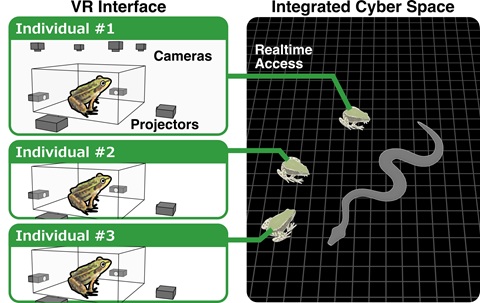 Animal experiment concept using VR technology
Profile

NISHIUMI Nozomi
Ph.D. (Science). Specializes in animal behavior and information engineering. Uses VR technology to place animals in virtual environments to study their decision-making and survival strategies in various situations. After graduating from Nagasaki University and working at the National Institute for Basic Biology of the National Institutes of Natural Sciences, he has served as a Specially Appointed Associate Professor at the Graduate School of Science and Technology and the College of Creative Studies at Niigata University since 2025.
*Article content and profile information are current as of July 2025.
Related Links
Tags (Keywords)
Read other articles
-
 Faculty's Column (Early-Career) January 27, 2026
How Today’s Students Are Making Their College Years Count
TAKASAWA Yojiro Assistant Professor of the Faculty of Economic Sciences -
 Research (Rikka) November 28, 2025
Production of High‑Purity Hydrogen and Basic Chemicals via High-Efficiency Biomass Conversion
Li Liuyun Assistant Professor, Faculty of Engineering -
 Faculty's Column (Early-Career) November 27, 2025
Microparticles Show Mysterious Connections whthin the Body
OHKURA Naoto Senior Lecturer, Operative Dentistry and Endodontics, Niigata University Medical & Dental Hospital