
Message for the 2026 Fall Entrance Ceremony
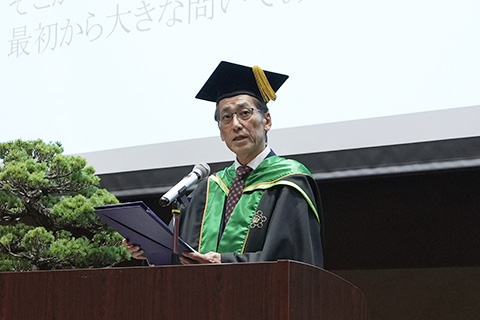
Message for the 2026 Fall Entrance Ceremony
New students,
On behalf of the faculty and staff of Niigata University, I warmly welcome all of you as you begin your studies with us today.
I would also like to offer my heartfelt congratulations to your families, friends, teachers, and all those who have supported you on your journey to this day.
Those gathered here today have followed many different paths.
Some of you are beginning a new field of study.
Some are seeking to deepen what you have already learned.
Others are embarking on serious research.
Some have come to Niigata from other parts of Japan, while others have come from countries around the world.
Entering a new environment brings excitement, but perhaps also some uncertainty.
Yet entering a new place also means encountering new knowledge and new people. Such encounters can challenge what you have long taken for granted, and may even change the way you think or the path you choose to pursue.
I believe that this is one of the great values of learning at a university.
A university is not simply a place where you receive answers that already exist.
Why is this so?
Is it really so?
Is this the way things should be?
University learning begins when you ask questions of your own, think deeply, encounter new knowledge and new perspectives, and develop ideas of your own.
For those of you pursuing advanced study and research, you will also be called upon to confront questions for which no one yet knows the answer, and to create new knowledge itself.
During your time at Niigata University, I would like you to value four things:
Ask questions.
Pursue them deeply.
Connect knowledge.
And bring that knowledge into society.
The first is to ask questions.
Learning begins when something makes you pause and ask, “Why?”
Something you hear in a class.
An unexpected result in an experiment or investigation.
A remark made by someone you meet in the community.
A conversation with someone whose views differ from your own.
From such moments, I hope you will cultivate questions of your own.
They do not need to be grand questions from the beginning.
And the questions you have today do not need to remain unchanged for years to come.
As you learn, meet people, and broaden your world, your questions themselves may change.
That, too, is part of what it means to learn at a university.
The second is to pursue your field deeply.
I hope that you will engage seriously with the field you have chosen.
Learn from the knowledge accumulated by those who came before you. Examine things for yourselves. Persist in confronting problems that do not yield easy answers.
That experience will give you a firm foundation of your own.
Science and technology, including generative artificial intelligence, are advancing rapidly. It has become easier than ever to gather vast amounts of information and obtain answers.
For that very reason, what matters more than ever is this:
What questions should we ask?
Why do those questions matter?
How should we judge the answers we receive?
The third is to connect knowledge.
Deepening your expertise is essential. But do not remain confined within the boundaries of your own field.
Many of the problems facing society today cannot be fully understood through a single academic discipline or a single set of values.
Niigata University is a comprehensive university where many fields of knowledge come together—the humanities, the social sciences, the natural sciences, and the medical and dental sciences.
Deepen your expertise.
And at the same time, connect knowledge across disciplinary boundaries.
Moving between these two directions is one of the great possibilities offered by studying at a comprehensive university.
Scholarship also crosses national borders.
By speaking with people from different countries, regions, and cultural backgrounds, you may come to recognize assumptions you had never realized you held.
I hope that here at Niigata University, you will meet many people and engage in meaningful dialogue with them.
The fourth is to bring knowledge into society.
The knowledge you gain at a university should not remain confined to classrooms and laboratories.
Through learning, you begin to see things that you could not see before. You become aware of problems that society itself may not yet have recognized. And through the knowledge you create, you can open new possibilities for people and for society.
That is another great value of learning at a university.
Niigata, where you will now live and study, faces many of the challenges that Japan and the wider world must confront: population decline, an aging society, healthcare, food and agriculture, the environment, and disaster preparedness.
But a region is not only a place where problems exist.
It can also be a place where new knowledge is created, where new forms of society are imagined, and where new possibilities are shown to the world.
Look at the world from Niigata.
And by learning about the world, look again at Niigata.
Bring knowledge created in this region to the world.
And bring the knowledge of the world back to this region.
I hope that this movement between the local and the global will give rise to new questions and new value.
The founding philosophy of Niigata University is Autonomy and Creativity.
Autonomy does not mean doing everything on your own.
It means learning from those who came before you, discussing ideas with others, listening to views different from your own, and, when necessary, questioning your own assumptions.
And after doing so, it means thinking for yourself and taking responsibility for your own judgment.
That, I believe, is autonomy.
And beyond autonomy lies creativity.
Creating new knowledge.
Connecting different forms of knowledge.
Questioning what has long been taken for granted.
And using what we discover to contribute to the future of people and society.
From today, you are no longer simply recipients of knowledge.
You are beginning a journey in which you will question knowledge, pursue it deeply, connect it with other knowledge, and create knowledge of your own.
There will be times when things do not go as you hope. Your studies or research may not progress as expected, and you may find yourselves uncertain about the path you have chosen.
At such times, pause and think. Talk with others. And when necessary, reconsider the questions you are asking.
Learning at a university does not mean simply following in a straight line along a path you chose at the beginning.
It also means learning, meeting people, reconsidering your direction, and gradually creating a path of your own.
At Niigata University, I hope that you will deepen your expertise while also encountering many different people and forms of knowledge, and that through those encounters you will discover new ways of seeing the world.
And I hope that you will use the knowledge and experience you gain here not only for yourselves, but also to help create a better future for people and society.
From today, you are new members of the Niigata University community.
I sincerely hope that your time here will be filled with learning and discovery, with challenges and meaningful encounters.
Congratulations on your admission to Niigata University.
October 1, 2026
Toshiyuki Someya
President, Niigata University