
Far Away Yet Close to Home: Solar Flares
Have you ever heard of a “solar flare”? The term refers to explosive phenomena that occur on the Sun. While solar flares happen with some frequency during some periods, they were rarely reported in the general media when I was a student over a decade ago. Recently, they’ve been featured on TV shows, and when major flares occur, they make the news on the internet. So, in what ways do solar flares affect our lives?
Because the Sun is extremely hot, it constantly emits radiation that is harmful to the human body, such as X-rays, ultraviolet rays, and high-energy charged particles. When a solar flare occurs, the intensity of the X-rays and ultraviolet rays can temporarily surge to hundreds of times their normal levels, and large quantities of charged particles may be released and travel toward the Earth. However, you do not need to worry. Most of the X-rays and ultraviolet rays are absorbed by the Earth’s upper atmosphere, so very little reaches the Earth’s surface. Furthermore, in mid-latitude regions like Japan, charged particles are blocked by the Earth’s magnetic field and cannot penetrate the atmosphere. As a result, it is highly unlikely that we on the ground will suffer any direct health effects.
On the other hand, in high-latitude regions such as the Arctic and Antarctic, magnetic field lines extend all the way to the Earth’s surface, allowing high-energy particles to enter the atmosphere. This causes a phenomenon known as the aurora. The occurrence of the aurora depends on a complex interplay of factors, including the orientation of the Sun’s and Earth’s magnetic fields and the energy of the particles involved. Therefore, a solar flare does not necessarily guarantee that the aurora will be visible. If you are fortunate enough to witness the aurora with your own eyes, you will recognize what a truly special experience it is.
While the effects of solar flares are limited on the ground, they cannot be ignored in Earth’s upper atmosphere or outer space. 2003 saw the largest solar flare recorded since the start of modern, precise observations causing malfunctions and temporary disruptions in satellites from various countries, including Japan’s Midori-II. In 2022, 40 SpaceX Starlink satellites were lost due to the effects of a solar flare. In addition, communication disruptions and GPS malfunctions associated with massive flares have been reported, and aircraft flying through the Arctic Circle sometimes have to change their routes for safety reasons. When a large-scale flare occurred in November 2025, the possibility of malfunctions in the flight control computers installed on some aircraft models from major manufacturers was reported, necessitating hardware and software replacements and upgrades. As a result, flight delays and cancellations occurred worldwide. While you likely don’t feel the effects of solar flares in your daily life, in our technology-dependent modern world, they are no longer merely distant cosmic phenomena. As society becomes more convenient, the prediction of space phenomena will become increasingly important.
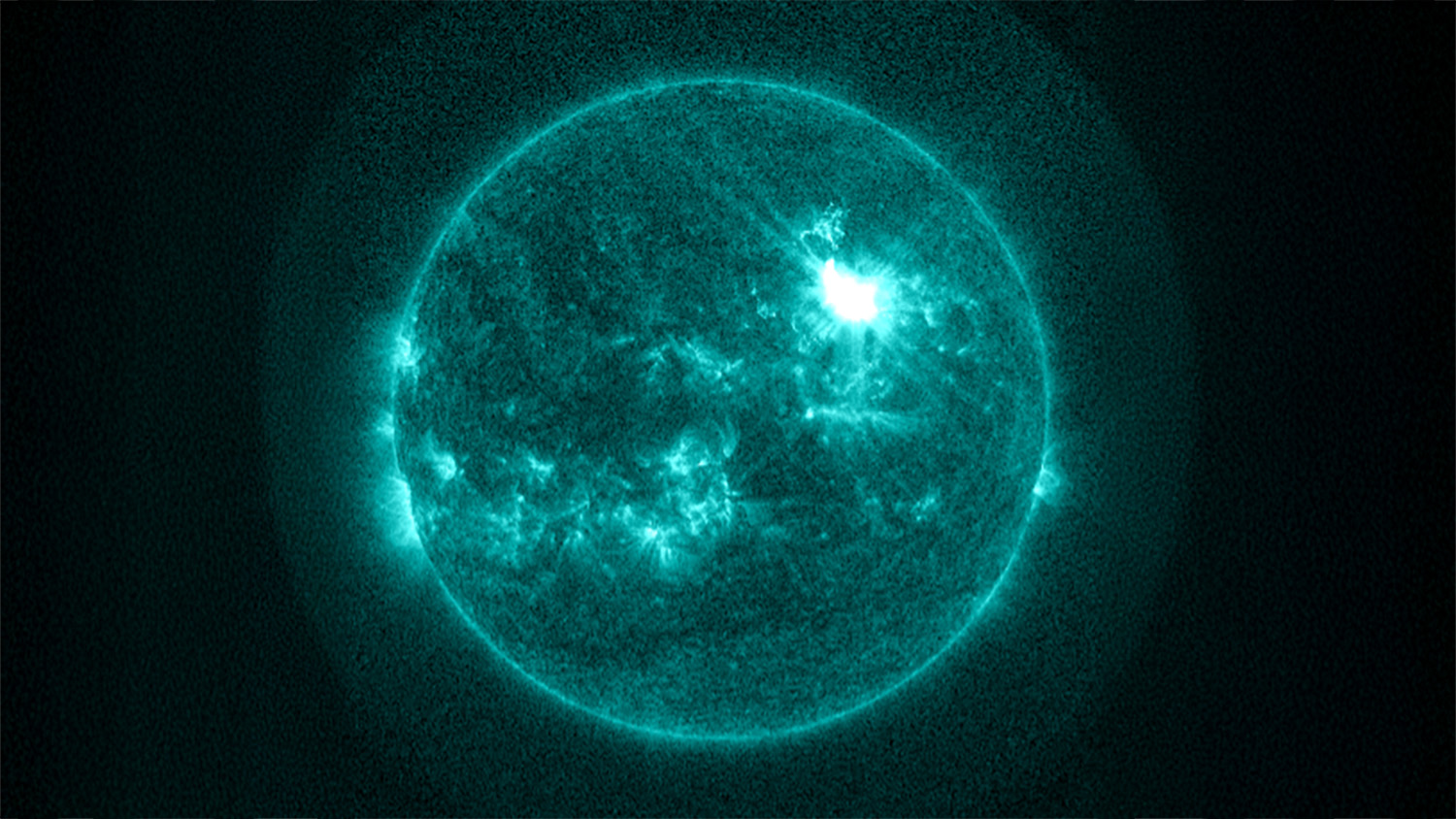
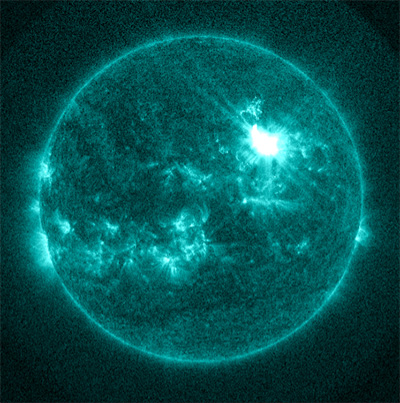 An example of a solar flare observed on November 11, 2025 (©NASA/SDO).
This image captures ultraviolet radiation from the Sun (wavelength 131Å).
The flare is occurring in the particularly bright area at the top right.
Profile

KANEKO Takafumi
Ph.D. (Science). Specializes in astronomy and solar physics. While involved in training middle school technology teachers, he conducts research on numerical modeling of solar flares using supercomputers.
*Article content and profile information are current as of January 2026.
Tags (Keywords)
Publication
This article is also featured in Rikka, Niigata University’s quarterly public relations magazine, No.54/55.
Read other articles
-
 Faculty's Column (Early-Career) October 14, 2026
How Does Your Body Change With Breastfeeding? Looking Ahead to Women’s Long-Term Health
YAGYUUDA Noriko Assistant Professor, School of Health Sciences, Faculty of Medicine -
 Research (Rikka) September 29, 2026
Research on Local Ingredients: Aiming to Uncover Health Benefits and Quantify Flavor
YAMAGUCHI Tomoko Professor, Faculty of Education & Faculty of Agriculture -
 Faculty's Column (Rikka) September 29, 2026
Mycobacterium Tuberculosis: Humanity’s Number 1 Killer both Past and Present
MATSUMOTO Sohkichi Professor, Graduate School of Medicine, Dentistry, and Health Sciences