
Notable birth cohort effects on the incidence trend of renal replacement therapy in Japan
April 12, 2023
A new Japanese study reveals significant birth cohort effects on the incidence trend of ESKD requiring RRT.
"Different birth cohorts may have different levels of exposure to a particular risk factor, which may produce a change in disease incidence for individuals born at a particular time, i.e. a cohort effect," said Dr. Wakasugi, the corresponding author of the study. "Age-Period-Cohort (APC) analysis, a statistical method to distinguish between age, period, and cohort effects, helps us assess if particular age groups or birth cohorts should be targeted for interventions."
Using data from the Japanese Society of Dialysis Therapy registry and national census between 1982 and 2021, the study revealed the risk of incident RRT initially rose in the birth cohorts, peaked, and then declined in recent birth cohorts in both sexes, but the peaks were different for each sex, showing elevated trends that peaked in the 1940–60s for men and 1930–40s for women.
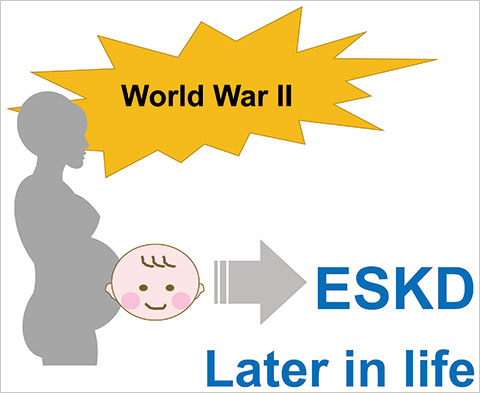
"Our findings suggest that men born in the 1940-60s and women born in 1930–40s may be important target populations to consider when reducing incidence rates of RRT among the Japanese population," said Dr. Wakasugi. "While the exact reasons for the cohort effects on the incidence rate for RRT cannot be determined precisely from our data, the influence of poor environmental conditions caused by war at birth may increase the risk of ESKD requiring RRT. "During World War II (1939–45) and for a few years thereafter, the nutrition of the Japanese population was extremely poor. Poor maternal nutrition can cause low birth weight, which has been associated with a subsequent disproportionally high incidence of hypertension, diabetes mellitus, cardiovascular disease, and chronic kidney disease. This hypothesis is supported by a previous study that applied the APC model using the Taiwan Renal Disease System Databases and showed that the birth cohort of 1943–47 (during the period of World War II) had the highest risk of dialysis compared with the other birth cohorts. This explanation, however, would not apply to the high risk of incident RRT among men born in the 1960s. Thus, other reasons may be responsible for these findings."
Publication Details
Journal: Clinical and Experimental Nephrology
Title: Birth cohort effects in incident renal replacement therapy in Japan, 1982-2021
Authors:Minako Wakasugi, Ichiei Narita
doi: 10.1007/s10157-023-02345-x
News release
The article was released in EurekAlert, the online publication of the American Association for the Advancement of Science.
More News
-

Mapping Potential Conflict Zones Between Offshore Wind Development and Little Terns Across Japan: A New Spatial Screening Framework to Support Environmental Impact Assessment
Research results
-
A New Clue for Assessing the Body’s Response to Mild Electrical Stimulation of the Ear: Changes in Heart Rate Regulation Observed in 17 of 18 Participants
Research results
-
Insertion or deletion variants in TAF15 exon 15 are genetic factors impacting the prognosis of amyotrophic lateral sclerosis in a Japanese cohort
Research results
-
Distinct recombinant tau fibril conformations induce divergent propagation and neurodegenerative phenotypes in a model mouse
Research results